
FDA Process, Quality System & Manufacturing Compliance Advisory
Build FDA-Aligned Manufacturing Processes, Quality Systems, and Compliance Documentation
Entering the U.S. market requires more than product registration or label review. Manufacturers must be able to show that their products are produced under controlled processes, supported by proper documentation, quality procedures, production records, supplier controls, and compliance systems aligned with FDA expectations.
Trust FDA provides advisory services for building manufacturing processes, quality systems, production controls, and regulatory documentation for both U.S.-based facilities and international factories exporting products into the United States.
Our service is designed for manufacturers, brand owners, importers, distributors, OEM/ODM facilities, and companies that need to strengthen their internal compliance foundation before selling, importing, distributing, or scaling products in the U.S. market.
We help companies move beyond one-time registration and build a practical compliance system that can support daily production, supplier management, documentation control, audits, inspections, and long-term market access.
Who This Service Is For
U.S.-Based Manufacturing Facilities
Trust FDA supports facilities located in the United States that need to establish, improve, or formalize internal quality and compliance systems.
This may include:
- Food and dietary supplement manufacturers
- Cosmetic manufacturers
- Medical device manufacturers
- Contract manufacturers
- Private-label manufacturers
- Packaging and repackaging facilities
- Warehouses and distribution-related facilities
- Companies preparing for FDA inspection, retailer audit, or internal compliance review
We help U.S. facilities build clear procedures, improve documentation, strengthen production control, and prepare for regulatory or commercial compliance expectations.
International Factories Exporting to the United States
Trust FDA also supports factories outside the United States that manufacture products for the U.S. market.
This may include factories located in Vietnam, Asia, Europe, Latin America, or other countries producing goods for U.S. importers, brand owners, retailers, Amazon sellers, TikTok Shop sellers, distributors, or private-label brands.
For international factories, we help align internal documentation, production controls, supplier records, product files, testing documentation, and compliance procedures with U.S. market expectations.
This is especially important when the U.S. importer, distributor, retailer, or platform requests documentation to verify that the product and facility meet applicable FDA-related requirements.
Brand Owners, Importers, and Distributors
This service is also suitable for U.S. or international brand owners that work with third-party manufacturers.
Trust FDA can help brand owners and importers:
- Review the compliance readiness of OEM/ODM factories
- Build supplier qualification checklists
- Standardize product documentation before importation
- Coordinate documents between the brand owner, factory, importer, and distributor
- Review labels, claims, testing, and safety documentation
- Prepare documentation for retailers, marketplaces, or regulatory inquiries
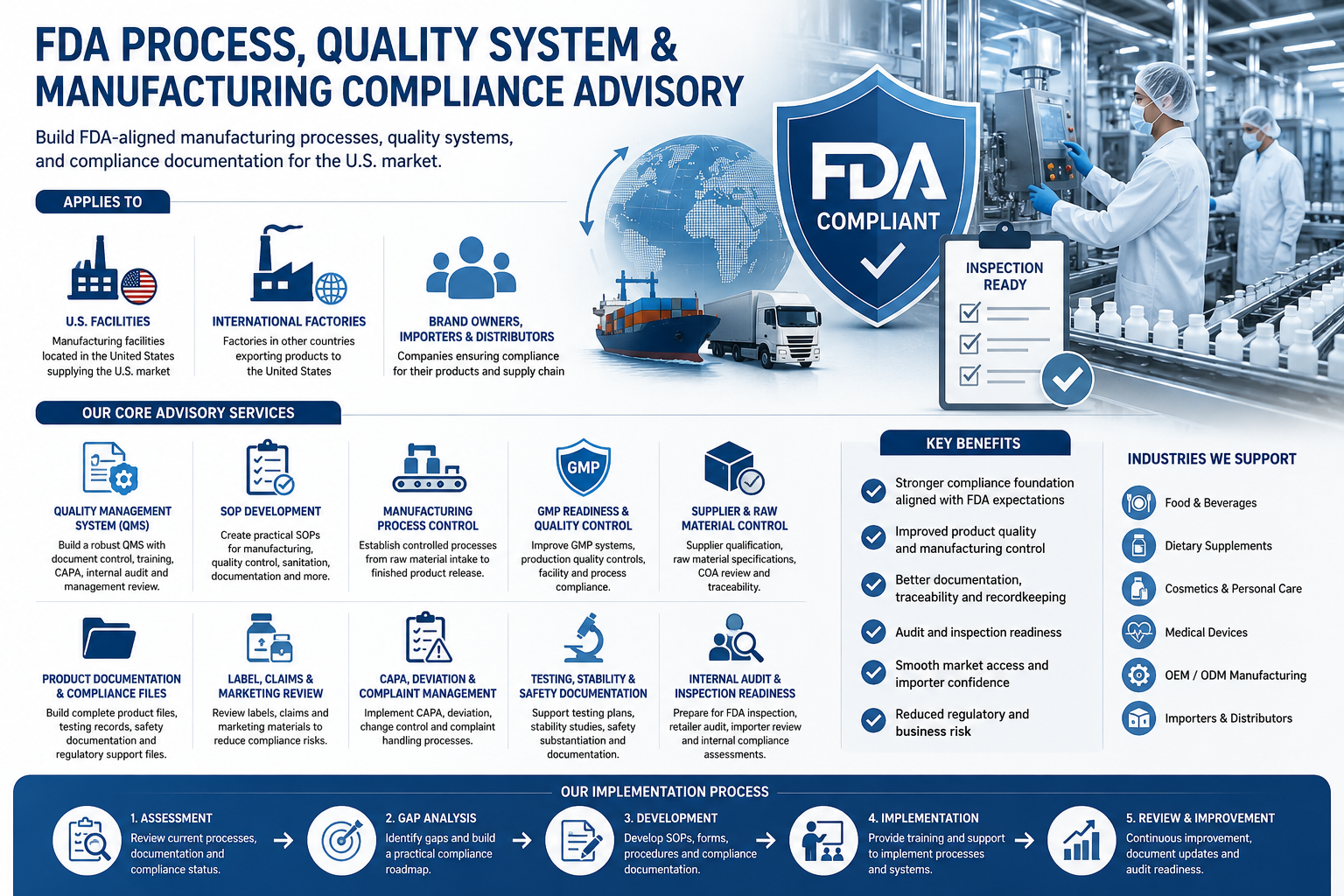
Our Core Advisory Services
1. Quality Management System Development
A Quality Management System, or QMS, provides the structure for managing documents, procedures, training, deviations, corrective actions, audits, complaints, and product quality records.
Trust FDA helps companies build a QMS that fits their product category, facility size, production model, and U.S. market needs.
Our QMS advisory may include:
- Quality Manual development
- SOP framework design
- Document control system
- Record retention system
- Training program development
- CAPA procedure
- Deviation tracking
- Change control procedure
- Complaint handling procedure
- Internal audit program
- Management review process
- Quality metrics and reporting system
A strong QMS helps companies create consistency, reduce operational errors, improve traceability, and demonstrate that quality activities are managed in a structured and documented way.
2. SOP Development for Manufacturing and Quality Control
Standard Operating Procedures, or SOPs, are the foundation of a controlled manufacturing environment. They help ensure that employees follow consistent steps, production activities are documented, and quality records can be reviewed when needed.
Trust FDA helps companies develop practical SOPs that reflect real production activities while supporting FDA-aligned compliance expectations.
SOP categories may include:
- Raw material receiving and inspection
- Supplier qualification
- Production process control
- Batch manufacturing
- Batch packaging
- Equipment cleaning
- Facility sanitation
- Line clearance
- In-process inspection
- Finished product release
- Product testing review
- Label control
- Document control
- Product hold, reject, and rework
- Product complaint handling
- Product recall procedure
- Adverse event reporting, when applicable
- Internal audit
- Corrective and preventive action
- Change control
- Training and personnel qualification
Our goal is to create SOPs that are not only written for compliance purposes, but also usable by the team in daily production and quality operations.
3. Manufacturing Process Control
Trust FDA helps companies establish clear production controls from raw material intake to finished product release.
This service focuses on how the product is actually manufactured, controlled, documented, and released. It does not focus on general business operations. Instead, it focuses on manufacturing compliance, quality control, and production documentation.
Manufacturing process control may include:
- Batch manufacturing records
- Batch packaging records
- Master manufacturing records
- Raw material specifications
- Finished product specifications
- In-process control points
- Equipment cleaning procedures
- Production area sanitation procedures
- Environmental monitoring, when applicable
- Line clearance procedures
- Lot numbering and traceability
- Hold, reject, rework, and release procedures
- Finished product release criteria
- Production deviation documentation
- Manufacturing change control
- Recall readiness documentation
These controls help companies demonstrate that products are manufactured consistently, records are maintained properly, and quality issues can be traced and addressed.
4. GMP Readiness and Production Quality Controls
Good Manufacturing Practice readiness is important for companies that want to build a reliable manufacturing system and prepare for customer audits, retailer reviews, FDA inspection, or importer due diligence.
Trust FDA helps companies assess and improve GMP-related systems based on the product type and facility operations.
GMP advisory may include:
- Facility and process gap assessment
- Production flow review
- Personnel hygiene procedures
- Equipment cleaning and maintenance procedures
- Raw material control
- Packaging material control
- Label control
- Batch record review
- Production deviation tracking
- Product release review
- Storage and warehouse control
- Pest control documentation
- Sanitation documentation
- Training documentation
- Internal GMP audit checklist
- Corrective action planning
The objective is to help the facility create a controlled, documented, and audit-ready production environment.
5. Supplier and Raw Material Control
Supplier and raw material control is a critical part of product quality and FDA-aligned compliance. Companies should be able to show where materials come from, how suppliers are qualified, how materials are reviewed, and how records are maintained.
Trust FDA helps companies build supplier and raw material control systems, including:
- Supplier qualification procedure
- Supplier approval checklist
- Supplier risk assessment
- Supplier audit checklist
- Quality agreement template
- Raw material specification
- Ingredient documentation file
- COA review process
- Incoming inspection protocol
- Approved supplier list
- Supplier corrective action process
- Traceability documentation
- Importer or distributor documentation package
For food and dietary supplement products, supplier control is also important because the U.S. importer may need documentation to support FSVP compliance. FSVP requires the U.S. importer to verify that foreign suppliers and products meet applicable FDA food safety standards, and inadequate FSVP documentation may create import risks.
6. Product Documentation and Compliance File Development
Trust FDA helps companies build organized product files that can support regulatory compliance, importer review, retailer onboarding, marketplace approval, and audit readiness.
Depending on the product category, product documentation may include:
- Product specification
- Formula or formulation review
- Ingredient list
- Raw material documentation
- Certificate of Analysis
- Certificate of Quality
- SDS, when applicable
- Manufacturing process summary
- Product testing records
- Stability testing protocol
- Microbiological testing plan
- Challenge test documentation, when applicable
- Safety substantiation file
- Label and claims support file
- Product information file
- Product listing support documentation
- Importer documentation package
- Retailer or marketplace compliance package
For cosmetic products, this may include safety substantiation, ingredient safety review, microbiological testing, stability testing, and safety assessment documentation.
For food or dietary supplement products, this may include ingredient review, product specifications, label support, testing documentation, and FSVP-related support.
For medical devices, this may include device specifications, labeling support, UDI/GUDID-related documentation, device listing support, and technical documentation coordination when applicable.
7. Label, Claims, and Marketing Compliance Review
Product labels and marketing claims are common sources of compliance risk in the U.S. market. Trust FDA helps companies review and improve product labels, claims, and supporting documents before products are sold, imported, listed online, or presented to retailers.
Our review may include:
- Product identity statement
- Ingredient statement
- Nutrition Facts or Supplement Facts review, when applicable
- Cosmetic ingredient declaration
- Directions for use
- Warning statements
- Net quantity statement
- Manufacturer or distributor information
- Intended use review
- Structure/function claims
- Cosmetic claims
- Disease claim risk review
- Marketing language review
- Website and marketplace claims review
- Amazon or TikTok Shop listing claim review
- Claims support file development
The goal is to reduce the risk of misleading claims, unsupported statements, incorrect labeling, or product positioning that may create regulatory concerns.
8. CAPA, Deviation, Change Control, and Complaint Handling
An effective compliance system must include procedures for identifying, investigating, correcting, and preventing quality problems.
Trust FDA helps companies build practical quality event systems, including:
- CAPA procedure
- Corrective action tracking
- Preventive action tracking
- Deviation report form
- Root cause analysis template
- Non-conforming product procedure
- Change control procedure
- Complaint handling procedure
- Adverse event intake process, when applicable
- Investigation report template
- Effectiveness check procedure
- Trend review process
- Management review reporting
These systems help companies respond to quality issues in a documented and consistent manner.
9. Testing, Stability, and Safety Documentation Support
Trust FDA helps companies identify and organize testing and safety documentation that may be needed for product compliance, retailer requirements, product launch, or audit readiness.
Depending on the product type, this may include:
- Stability testing planning
- Microbiological testing coordination
- Challenge testing planning
- Heavy metal testing documentation
- Preservative effectiveness support
- Finished product testing review
- Raw material testing review
- Product safety substantiation
- Ingredient safety review
- Product specification verification
- Testing summary report
- Documentation archive setup
The goal is to help companies maintain documentation that supports product safety, quality, and compliance expectations.
10. Internal Audit and Inspection Readiness
Trust FDA helps companies prepare for internal audits, customer audits, retailer audits, marketplace compliance reviews, importer due diligence, and FDA inspections.
Inspection readiness support may include:
- Facility compliance gap assessment
- Document readiness review
- Internal audit checklist
- Mock audit or mock inspection
- GMP readiness review
- QMS readiness review
- Batch record review
- CAPA readiness review
- Supplier file review
- Label and claims review
- Product safety file review
- Corrective action plan
- Audit response preparation
- Inspection response support
- Employee training before audit or inspection
The goal is to help companies identify weaknesses before an auditor, retailer, importer, or regulator identifies them.